




Sourcing goods and services from black-owned and local businesses is one of the key ways we foster change and share value. This is aligned with our socio-economic development goal 3, ‘Improving access to income generation opportunities’. In South Africa, this imperative is driven by broad-based black economic empowerment (B-BBEE), a government policy that promotes economic participation and ownership among historically disadvantaged individuals.
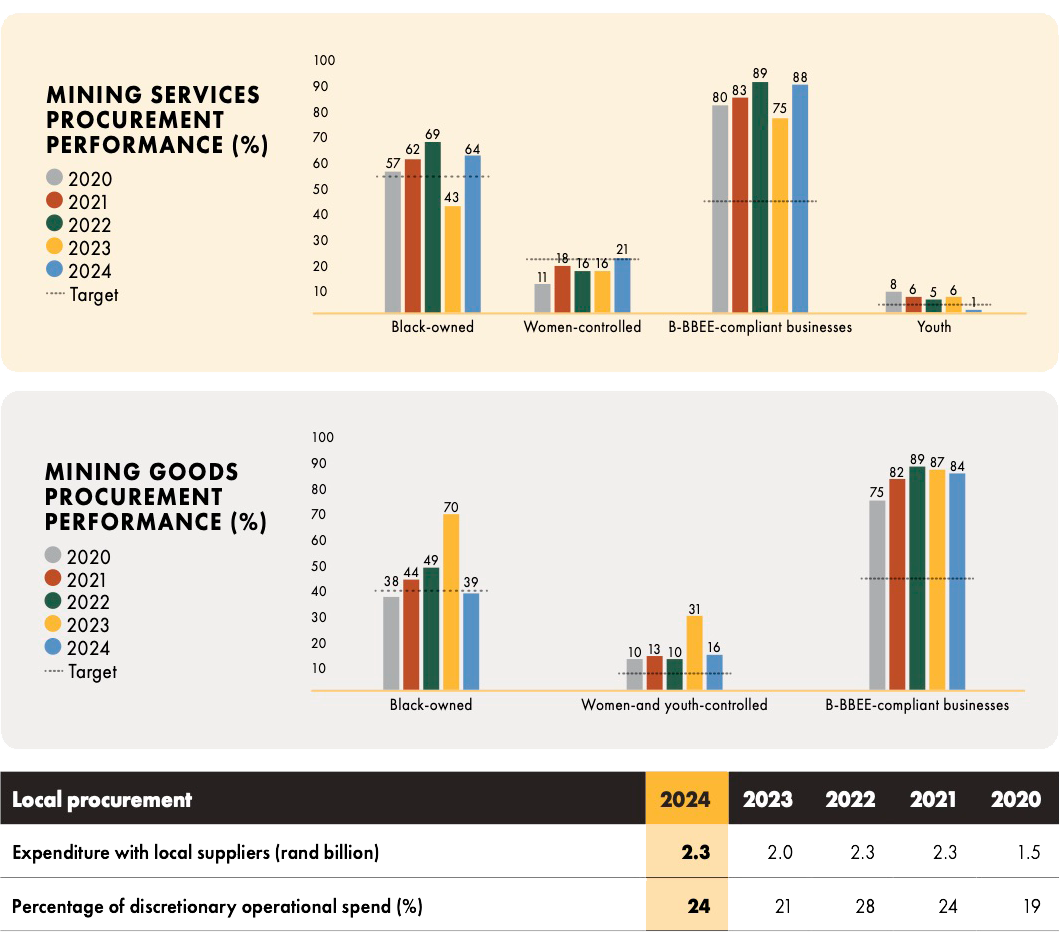
We strive to exceed compliance with the procurement targets set by the Mineral and Petroleum Resources Development Act. These targets are included in each mine’s SLP and relate to the purchasing of goods and services from historically disadvantaged South Africans, black women- and youth-owned entities, and businesses that are B-BBEE-compliant.
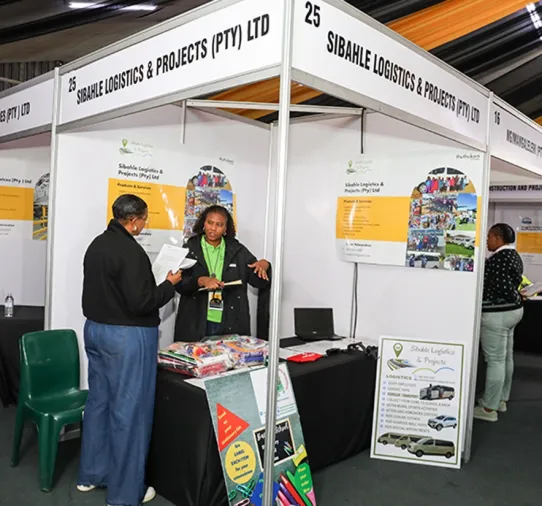
Considerable emphasis is placed on directing opportunities to businesses that operate in the communities that host our mine sites as a way of promoting sustainable local economic development and employment.
Ambitious preferential procurement targets, ring-fenced opportunities for BEE and local suppliers, and the segmentation of high-value contracts with well-established businesses are all ways we continue to reduce the barriers to entry for smaller enterprises. Total expenditure at our South African operations in 2024 was R9.7 billion. Of this, R7.2 billion was spent with transformed businesses. The proportion of discretionary expenditure allocated to businesses in host communities increased by 1% to R2.0 billion, representing 24% of our discretionary spend, up from 21% in 2023.
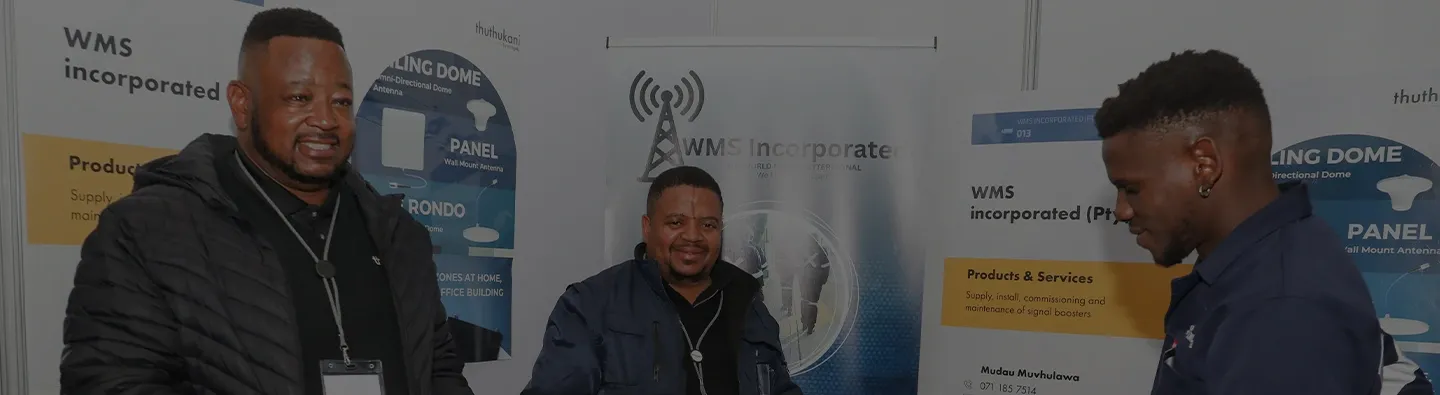
Progress in this area is supported by Thuthukani, our ESD programme, which is expanding the pool of local suppliers capable of providing goods and services that meet our quality, delivery and safety standards. Thuthukani provides entrepreneurial skills training, technical enablement and loan funding at preferential interest rates.
Commercial and operational constraints limit our capacity to employ people, procure goods and services and invest in social initiatives. However, through collaboration with large supplier partners, we can amplify our impact by co-creating shared sustainable value.
These partnerships, often with original equipment manufacturers and multinational organisations, include contractual commitments that contribute to local development. These typically relate to the:
- employment of a specified percentage of local people;
- transfer of skills to emerging companies;
- procurement from local SMMEs; and
- contributions to local CSI.
These commitments are fulfilled either in partnership with our mines or as independent initiatives, and further enhance socio-economic benefits in the communities where we operate. Suppliers working at our Elders project site have delivered projects to the value of more than R4.3 million alone. These include the installation of eco-latrines, boreholes and solar street lighting, enhancements to a nursery school and the complete renovation of eight classrooms at a local high school.
During the year, we partnered with capital equipment supplier Barloworld Equipment on two education-related projects.
- The first saw Goedehoop and Barloworld Equipment erect two containerised units to address space constraints at Kwazamokuhle Secondary School in Hendrina. These units include a fully furnished boardroom, a staffroom with workstations and a kitchenette, offering educators a functional space to plan lessons, mark papers and hold meetings.
- In the second project, Barloworld Equipment partnered with Mafube to build a science laboratory at Bankfontein Combined School and a library at Beestepan Secondary School.
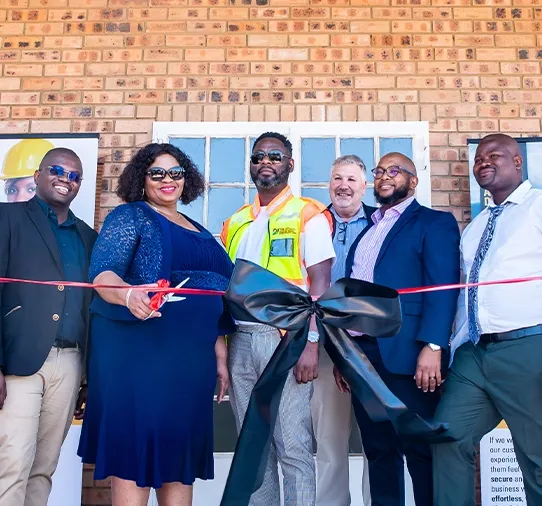
Mafube’s partnership with explosives provider Enaex resulted in the donation of five interactive white boards, six laptops, projectors and the construction of a fence at Ipani Primary School.
Strata Mining Services, a supplier of proximity detection systems to our underground mines, invested in 25 young people who completed a basic electrical training programme. Finally, security provider Fidelity will subcontract a large portion of its contract value to a host community supplier which will be responsible for providing personnel and managing 30% of the scope of work.
We are committed to operating responsibly and with integrity, and expect all our business partners to do the same.
During the year, the board approved our responsible sourcing policy, which sets the foundation for relationships with suppliers, vendors, agents, consultants and contractors. The policy ensures legal compliance and emphasises our commitment to human rights. It covers key areas such as labour standards, health and safety, environmental management and business integrity. The policy will be rolled out in 2025. Training will be provided for all suppliers, with special emphasis on businesses in host communities to better enable them to align themselves with these standards.

In 2024, we undertook an internal process to identify high-risk suppliers within our procurement network. Building on this in 2025, we will engage an external party to conduct comprehensive audits on high-risk suppliers, focusing on risks related to human rights, sustainability and legal compliance.
As part of our effort to enhance sustainability in our supply chain, we mapped the top 60% of our supplier base by spend in 2024, and initiated a review of their reporting on Scope 1, 2 and 3 greenhouse gas emissions and emission reduction targets. The mapping covered purchased goods and services, capital goods and upstream transportation. Approximately half of the suppliers mapped currently track their emissions and have targets in place. Most suppliers who do not report on emissions are SMMEs. The next step will involve engaging these companies to support and guide their emissions reduction pathways.
Suppliers and service providers are expected to operate within the ethical and legal parameters set out in our business integrity policy, our standard terms and conditions for suppliers and our code of conduct, which are all available on our website. These policies make it clear that we are implacably opposed to corruption. We will neither give nor accept bribes nor permit others to do so in our name, either in our dealings with public officials or with suppliers and customers.
Employees, contractors, suppliers, business partners and other external stakeholders are encouraged to report and raise concerns about conduct that is contrary to the values and standards described in our business integrity policy using our anonymous tip-off line, HAIBO!.